Mental Health is a Skill|Free Tools to Build it
← All homework

CBT-I sleep diary

Your Sleep Log

Fill in one morning at a time, within an hour of getting up. The log works out your time in bed, your time asleep and your sleep efficiency, and after a week it shows what to do with your sleep window.

2 minutes a morningWorks out the math for youStays on this device

This morning

About last night
1
2
3
4
5
6
7
8
9Sleep quality 1 very poor, 5 very good
About yesterday
10
11
12
13
Fill in lines 1 and 8 to see your numbers.

Saved in this browser only. Nothing is sent to OmniPsyche. Clearing your browser's site data erases it, so print or save a PDF for a lasting copy.

Your week

Your numbers appear here once you have saved a morning.

Your sleep window (optional)

Add your wake time to see your starting bedtime after a week. Already following the CBT-I guide? Add your set bedtime too, and the log will show next week's.

DateInto bedUpTime in bedTime asleepEfficiencyQuality
No mornings saved yet.
Sleep efficiency calculator

What to do with your number

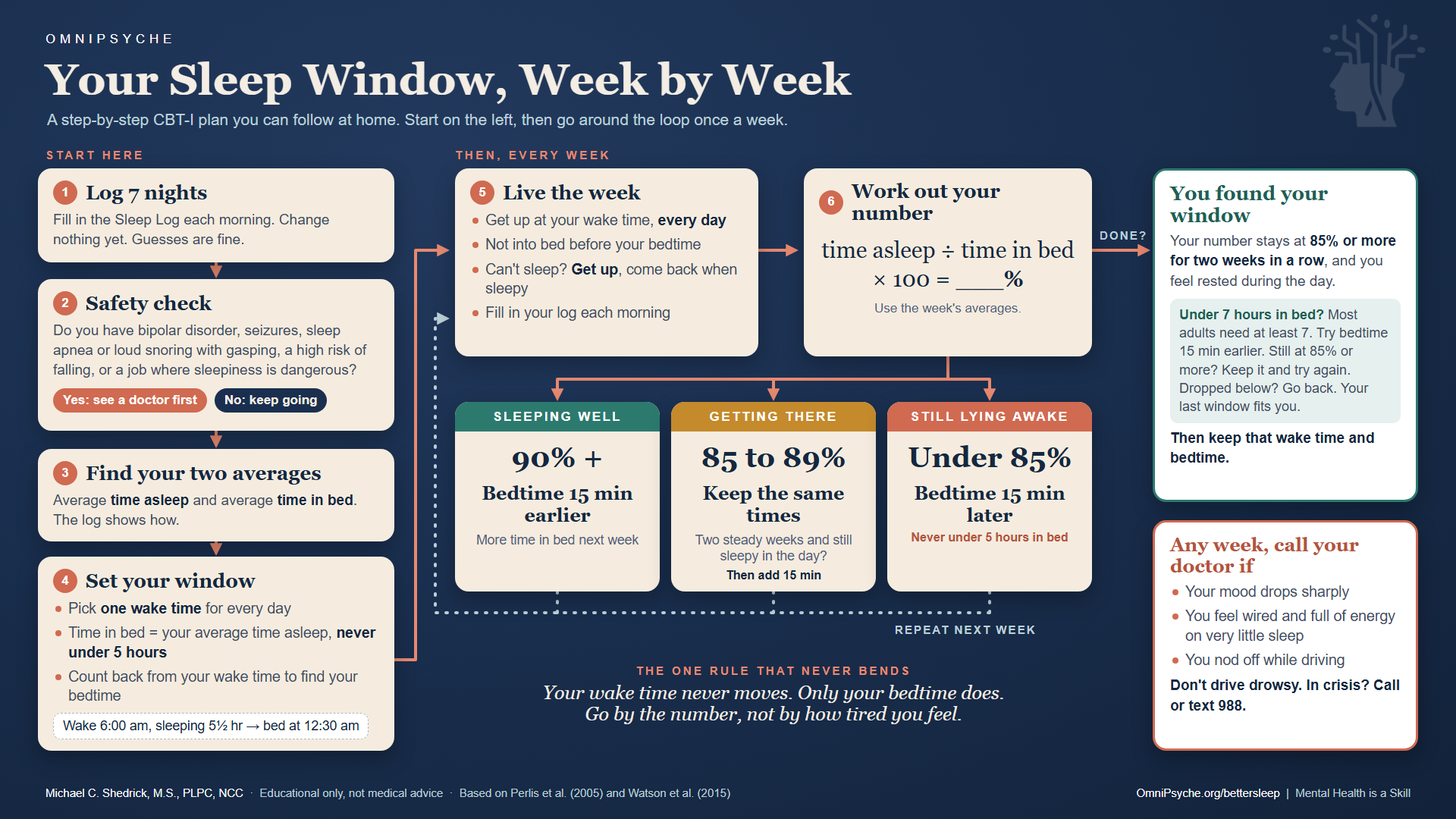
Start on the left, then go around the loop once a week. Your wake time never moves; only your bedtime does.

Flow chart, Your Sleep Window, Week by Week. Start: log 7 nights, a safety check, find your average time asleep and time in bed, then set a window of your average sleep, never under 5 hours, counted back from one wake time. Every week: live the week, work out time asleep divided by time in bed times 100. 90% or more, bedtime 15 minutes earlier. 85 to 89%, keep the same times, and after two steady weeks add 15 minutes if still sleepy. Under 85%, bedtime 15 minutes later, never under 5 hours. Done when the number stays at 85% or more for two weeks and you feel rested; under 7 hours, test 15 more minutes. Call your doctor if your mood drops sharply, you feel wired on little sleep, or you nod off while driving.
Tap to open the full-size chart. The full steps are in the free CBT-I guide, How to Finally Sleep.

Before you shorten your time in bed

Talk to a doctor first if you have bipolar disorder, seizures, sleep apnea (or loud snoring with gasping or pauses in breathing), a high risk of falling, or a job where sleepiness is dangerous.

Expect to feel sleepier during the day at first. Don't drive or use machinery while drowsy.

Never stop a prescribed sleep medicine on your own. Ask the person who prescribed it. In crisis? Call or text 988, any time.

Want to understand CBT-I in depth?

CBT-I for Counselors on OmniTaught teaches the full protocol in short lessons with practice questions: assessment, sleep restriction, stimulus control, sleep beliefs and troubleshooting. Built for clinicians, open to anyone curious.

Open the course

Michael C. Shedrick, M.S., PLPC, NCC. This log is for educational purposes only. It is not medical advice and does not replace care from your doctor, prescriber or therapist. The questions follow the Consensus Sleep Diary (Carney et al., Sleep, 2012); the sleep window rules follow Perlis et al. (2005).